Winter Special Limited Time 65% Discount Offer - Ends in 0d 00h 00m 00s - Coupon code: myex65

Home > The Open Group > Enterprise Architecture > OGEA-101

OGEA-101 TOGAF Enterprise Architecture Part 1 Exam (English) Question and Answers

Question # 4

According to the TOGAF standard, what term describes an individual with an interest in a system?

A.

stakeholder

B.

consumer

C.

lead architect

D.

sponsor

Full Access
Question # 5

Which section of the TOGAF template for Architecture Principles should describe the relationship to other principles?

A.

Name

B.

Rationale

C.

Statement

D.

Implications

Full Access
Question # 6

Complete the sentence. The architecture domains that are considered by the TOGAF standard as subsets of an overall enterprise architecture are Business, Technology,

A.

Logical and Physical

B.

Information and Data

C.

Capability and Segment

D.

Application and Data

Full Access
Question # 7

According to the TOGAF Standard, what are the two levels of risk that should be monitored?

A.

Initial and Residual level

B.

Operational and Strategic level

C.

Mitigated and Revised level

D.

Technical and Financial level

Full Access
Question # 8

What are the following activities part of?

• Initial risk assessment

• Risk mitigation and residual risk assessment

• Risk monitoring

A.

Risk Management

B.

Phase A

C.

Security Architecture

D.

Phase C

Full Access
Question # 9

Which one of the following classes of information within the Architecture Repository would typically contain a list of the applications in use within the enterprise?

A.

Reference Library

B.

Architecture Metamodel

C.

Architecture Landscape

D.

Governance Log

Full Access
Question # 10

Which of the following describes a purpose of Architecture Principles?

A.

To describe likely impacts resulting from successful deployment of the target architecture.

B.

To establish a common understanding of how to control the business in pursuit of strategic objectives

C.

To provide a better understanding about the enterprise's culture and values

D.

To form a contract between sponsoring organization and the enterprise architects

Full Access
Question # 11

Complete the sentence Business Transformation Readiness Assessment is_________________.

A.

a joint effort between corporate staff lines of business and IT planners

B.

to ensure the active support of powerful stakeholders

C.

a way to put building blocks into context thereby supporting re-usable solutions

D.

widely used to validate an architecture that is being developed

Full Access
Question # 12

In the ADM, what is the name for documents that are not finished and not approved?

A.

interim

B.

draft

C.

version 0.1

D.

incomplete

Full Access
Question # 13

What ensures that a project transitioning into implementation also smoothly transitions into appropriate Architecture Governance?

A.

Implementation Strategy

B.

Implementation Governance Model

C.

Transition Plan

D.

Migration Plan

Full Access
Question # 14

Which statement best summarizes the TOGAF Content Framework?

A.

It shows the detailed relationships and interactions between information entities.

B.

It is fixed and should not be changed or modified.

C.

It is organized based on the phases of ADM.

D.

It provides lifecycle management capabilities to create and manage architectures.

Full Access
Question # 15

What should be put in place through organization structures, roles, responsibilities, skills and processes to carry out architectural activity effectively?

A.

An EA Capability

B.

An Enterprise Architecture

C.

An EA framework

D.

An EA repository

Full Access
Question # 16

Complete the sentence. The TOGAF standard covers the development of four architecture domains, Application, Business, Data and ____________

A.

Technology

B.

Transition

C.

Segment

D.

Capability

Full Access
Question # 17

In which phase(s) of the ADM would you deal with the actions resulting from a transformation readiness assessment?

A.

Phase F

B.

Phase G

C.

Phase E and F

D.

Phase A

Full Access
Question # 18

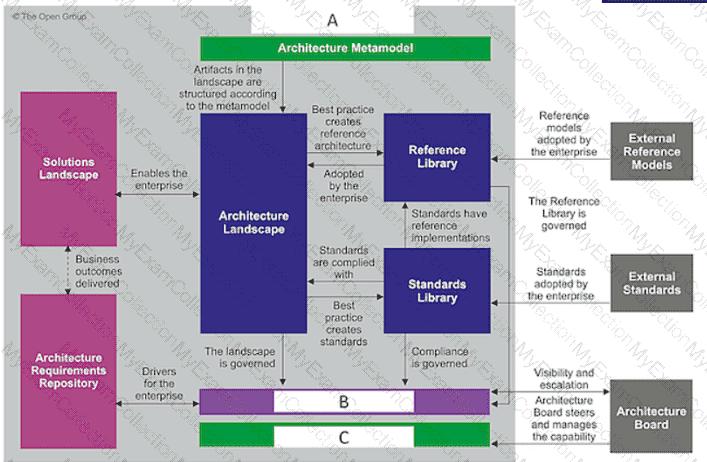
Consider the illustration.

What are the items labelled A B and C?

A.

A-Solution Landscape, B-Architecture Requirements Repository. C-Architecture Landscape

B.

A-Architecture Landscape B-Architecture Requirements Repository C-Solutions Landscape

C.

A-EA Landscape, B-Requirements Repository. C-Artifacts Landscape

D.

A-Architecture Requirements Repository, B-Solutions Repository, C-Architecture Landscape

Full Access
Question # 19

Consider the following statements.

1. All processes, decision-making, and mechanisms used will be established so as to minimize or avoid potential conflicts of interest.

2. More effective strategic decision-making will be made by C-Level executives and business leaders.

3. All actions implemented and their decision support will be available for inspection by authorized organization and provider parties.

4. Digital Transformation and operations will be more effective and efficient.

Which statements highlight the value and necessity for Architecture Governance to be adopted within organizations?

A.

1 & 4

B.

1 & 3

C.

2 & 4

D.

2& 3

Full Access
Question # 20

Consider the following statement:

According to the TOGAF Standard a governed approach of a particular deliverable will ensure a system of continuous monitoring to check integrity changes decision-making and audit of all architecture-related activities

Which deliverable is being referred to?

A.

An Architecture Contract

B.

The Architecture Definition Document

C.

The Architecture Vision

D.

The Statement of Architecture Work

Full Access
Question # 21

Consider the image showing basic architectural concepts.

What are items A and B?

A.

A-Architecture Viewpoint, B-Architecture View

B.

A-Architecture Board, B-Architecture Capability

C.

A-Candidate Architecture, B-Trade-off

D.

A-Requirement. B-Candidate Architecture

Full Access
Question # 22

How does an Enterprise (Architecture) Metamodel provide value?

A.

It defines parameters, structures, processes that support governance

B.

It forms an architecture completeness-check for use in an enterprise

C.

It leverages reference material for the creation of new architectures

D.

It identifies candidate architecture roadmap components by analyzing gaps

Full Access
Question # 23

What can be introduced to formalize a joint agreement between development partners and sponsors on the deliverables, quality, and fitness-for-purpose of an architecture?

A.

Architecture Contracts

B.

The Statement of Architecture Work

C.

Service Level Agreements

D.

Non-disclosure Agreement

Full Access
Question # 24

Which of the following best describes a purpose of the Gap Analysis technique?

A.

To validate non-functional requirements

B.

To establish quality metrics for the architecture

C.

To determine service levels for the architecture

D.

To identify missing functions

Full Access
Question # 25

Which of the following best describes the purpose of the Gap Analysis technique?

A.

To govern the architecture throughout its implementation process

B.

To develop a set of general rules and guidelines for the architecture

C.

To identify items omitted from the Target Architecture

D.

To allocate resources for architecture projects

Full Access
Question # 26

What are the four architecture domains that the TOGAF standard deals with?

A.

Business, Data, Application, Technology

B.

Capability, Segment, Enterprise, Federated

C.

Baseline, Candidate, Transition, Target

D.

Application, Data, Information, Knowledge

Full Access
Question # 27

Complete the sentence. Architecture effort at the Logical abstraction level is about:

A.

Decomposing the requirements to understand the problem, and what is needed to address the problem, without unduly focusing on how the architecture will be realized

B.

Managing the allocation and implementation of physical components to meet the identified logical components

C.

Identifying the kinds of business, data, application, and technology components needed to achieve the services identified in the conceptual level

D.

Understanding the environment in which an enterprise operates and the context in which architecture work is planned and executed

Full Access
Question # 28

Which statement best describes the main purpose of the TOGAF Content Framework?

A.

To address IT system concerns relevant to an enterprise.

B.

To store the artifacts identified in the Architecture Repository.

C.

To drive consistency in the outputs when following the ADM.

D.

To prevent gaps in the target architecture deliverable set.

Full Access
Question # 29

Consider the following descriptions of deliverables consumed and produced across the TOGAF ADM cycle.

Which deliverables match these descriptions?

A.

1 Architecture Requirements Specification - 2 Request for Architecture Work - 3 Statement of Architecture Work - 4 Architecture Principles

B.

1 Statement of Architecture Work - 2 Architecture Principles - 3 Architecture Requirements Specification - 4 Request for Architecture Work

C.

1 Architecture Principles - 2 Architecture Requirements Specification - 3 Request for Architecture Work - 4 Statement of Architecture Work

D.

1 Request for Architecture Work - 2 Statement of Architecture Work - 3 Architecture Principles - 4 Architecture Requirements Specification

Full Access
Question # 30

Consider the following ADM phases objectives.
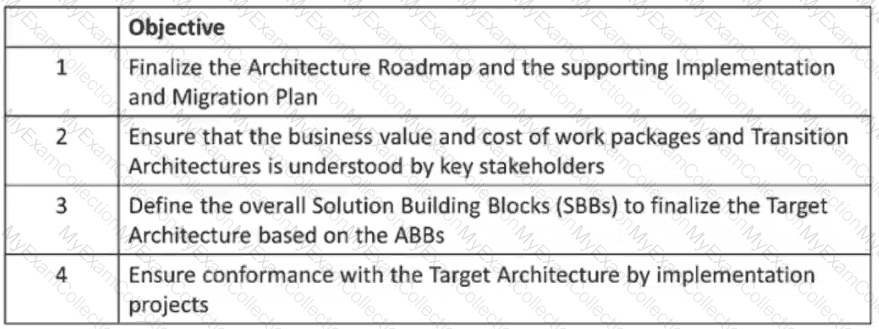
Objective:

1.Develop the Target Data Architecture that enables the Business Architecture and the Architecture Vision

2.Develop the Target Business Architecture that describes how the enterprise needs to operate to achieve the business goals

3.Develop a high-level aspirational vision of the capabilities and business value to be delivered as a result of the proposed Enterprise Architecture

4.Identify candidate Architecture Roadmap components based upon gaps between the Baseline and Target Technology Architectures

Which phase does each objective match?

A.

1B-2D-3A-4C

B.

1C-2D-3B-4A

C.

1C-2B-3A-4D

D.

1A-2B-3C-4D

Full Access
Question # 31

Which of the following does the TOGAF standard describe as a package of functionality defined to meet business needs across an organization?

A.

An application

B.

A deliverable

C.

A solution architecture

D.

A building block

Full Access
Question # 32

Complete the sentence The Architecture Landscape is divided into levels known as__________________________.

A.

Gaps Plateaus, and Target Architectures

B.

Baseline. Transition and To Be Architectures

C.

Segment Strategic and Capability Architectures

D.

Transitional Complete and incremental Architectures

Full Access
Question # 33

In which section of the TOGAF template for Architecture Principles would a reader find the answer to the question of “How does this affect me?”

A.

Statement

B.

Rationale

C.

Name

D.

Implications

Full Access
Question # 34

Consider the following statements about Architecture Partitioning:

    The TOGAF ADM requires a partitioning model for architecture development

    Architectures are partitioned when different teams need to work on different elements of the architecture at the same time

    Partitions can be used to facilitate architecture re-use

Which statements are correct?

A.

1, 2 and 3

B.

1 and 3

C.

1 and 2

D.

2 and 3

Full Access
Question # 35

Consider the following statements:

1. Each contracted party is required to act responsibly to the organization and its stakeholders.

2. All decisions taken, processes used, and their implementation will not be allowed to create unfair advantage to any one particular party.

3. Digital Transformation and operations will be more effective and efficient.

4. Strategic decision-making by C-Level executives and business leaders will be more effective.

Which statements highlight the value and necessity for Architecture Governance to be adopted within organizations?

A.

1 & 2

B.

2 & 3

C.

3 & 4

D.

1 & 4

Full Access
Question # 36

Which of the following is the ability to develop use and sustain the architecture of a particular enterprise using architecture to govern change?

A.

An EA Capability

B.

An EA repository

C.

An EA framework

D.

An Enterprise Architecture

Full Access
Question # 37

Consider the following statement.

Projects may cycle between ADM phases, in planned cycles covering multiple phases.

What does it illustrate?

A.

Requirements management

B.

Iteration

C.

Implementation governance

D.

Enterprise Architecture

Full Access
Question # 38

Complete the sentence. The purpose of the Gap Analysis technique is to _____.

A.

establish quality metrics for the architecture

B.

identify non-functional requirements for the architecture

C.

determine service levels for the architecture

D.

validate the architecture

Full Access
Question # 39

In which part of the ADM cycle do building block gaps become associated with work packages that will address the gaps?

A.

Phases G and H

B.

Phases F

C.

Phases B C and D

D.

Phase E

Full Access
Question # 40

Consider the following chart:

Which important concept for Enterprise Architecture Practitioners does it illustrate?

A.

Enterprise Architects must use Gantt charts to communicate with Stakeholders.

B.

An Enterprise Architecture must be developed in phases with a limited fixed duration.

C.

ADM phases must be run in a sequenced approach to produce the Architecture.

D.

ADM phases must be run simultaneously until the relevant information has been produced.

Full Access
Question # 41

Consider the following statements

1 A whole corporation or a division of a corporation

2 A government agency or a single government department

3 Partnerships and alliances of businesses working together such as a consortium or supply chain

What are those examples of according to the TOGAF Standard?

A.

Enterprises

B.

Business Units

C.

Organizations

D.

Architectures Scopes

Full Access
Question # 42

Complete the sentence. A business scenario describes

A.

shortfalls between the Baseline and Target Architectures

B.

business domain gaps, such as cross-training requirements

C.

general rules and guidelines for the architecture being developed

D.

business and technology environment in which those problems occur

Full Access
Question # 43

Consider the following statements:

1. Groups of countries, governments, or governmental organizations (such as militaries) working together to create common or shareable deliverables or infrastructures

2. Partnerships and alliances of businesses working together, such as a consortium or supply chain

What are those examples of according to the TOGAF Standard?

A.

Enterprises

B.

Organizations

C.

Business Units

D.

Architectures Scopes

Full Access